Firewood Banksia
Banksia menziesii
Firewood Banksia (Banksia menziesii) is a small, open tree or shrub of Western Australia's sandy coastal plains, from Pinjarra to Kalbarri. It is easy to grow in sandy soil, and its large pink, red or yellow flower heads feed honeyeaters and other nectar-eating animals for much of the year. Dwarf forms are also available.
- Sun
- Full sun
- Soil
- Deep, sandy, free-draining
- Water
- Dry once established
- Size
- 1.3–7 m tall
- Flowers
- Pink, red or yellow, Feb–Oct
Based on its natural habitat: little has been published on growing it.
Photo: Morten Ross, CC BY, via iNaturalist
- Photo: Millie Brady, CC BY, via iNaturalist
- Photo: David Thompson, CC BY, via iNaturalist
- Photo: Paul Prior, CC BY, via iNaturalist
Growing it
Firewood Banksia grows naturally in white, grey or yellow sand, from the coast to about 50 km inland, and it is adapted to the nutrient-poor sands of the Swan Coastal Plain. Plant it in deep, sandy soil that does not stay waterlogged. Clay soils are outside its natural range.
In the wild it usually regrows after damage from a lignotuber, a woody swelling at the base of the stem, or from epicormic buds, which are dormant buds under the bark.
It is a shrub at the northern end of its range and a small tree further south, so allow room for it to reach its full height.
What it looks like
Firewood Banksia is a tree or shrub with hairy stems. The grey-green leaves are about 14 to 25 cm long, with many lobes along each side that look like the serrations of a breadknife. This helps tell it from other banksias.
Each flower head is a woolly spike made up of hundreds of small flowers. The heads are pink to red or yellow, and appear from February to October. Its hairy seed pods are about 25 to 35 mm long.
For wildlife
Honeyeaters feed on the nectar of the flower heads and pollinate the flowers, along with pollinating insects. The noolbenger (honey possum), a tiny nectar-feeding marsupial, also depends on banksia flowers, though it is rarely seen.
Threatened wildlife that uses it
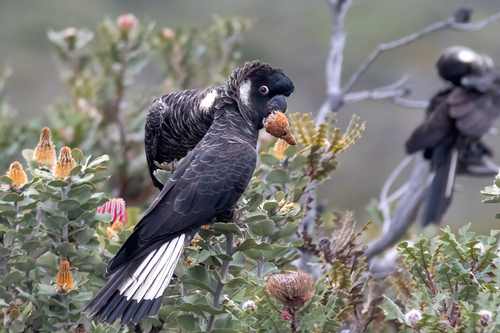
Flowers visited by
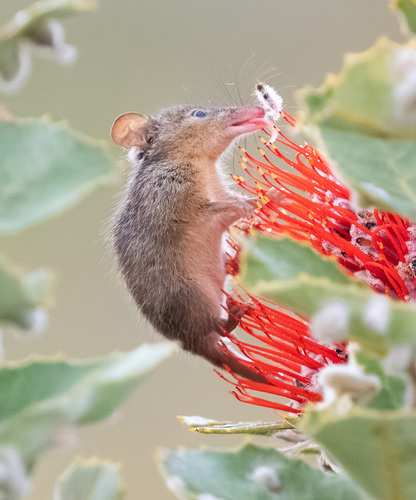
Eaten by
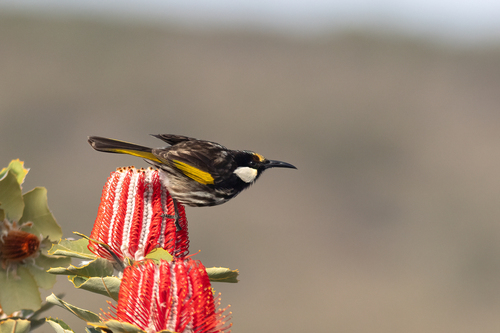
Also recorded with
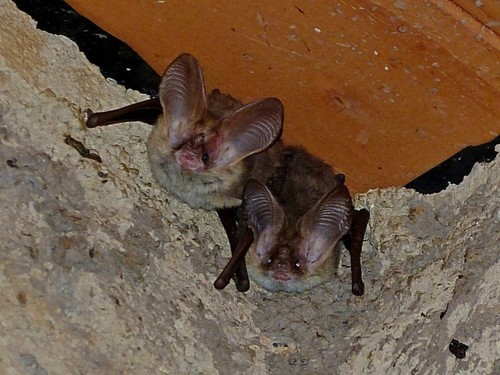
Where it belongs
Native to Western Australia, growing in sand from Pinjarra to Kalbarri, in the Swan Coastal Plain, Geraldton Sandplains, Jarrah Forest and Avon Wheatbelt regions. WA's Herbarium lists it as not threatened.
Suburbs it belongs in include:
Related plants
Sources
- Banksia menziesii R.Br., FloraBase, Department of Biodiversity, Conservation and Attractions (WA)
- Banksia menziesii, Friends of Queens Park Bushland
- Firewood banksia, Whiteman Park
- Native range: Australian Plant Census and Alien Flora of Australia. Wildlife links: GloBI and the studies cited on each animal page. All sources