Tropical Banksia
Banksia dentata
Tropical Banksia (Banksia dentata) is a gnarled small tree of northern Australia, growing from Cape York in Queensland across the Northern Territory to the northern Kimberley in Western Australia. It is the only banksia that also grows outside Australia, in southern New Guinea and the Aru Islands. Its yellow flower spikes suit a warm, frost-free garden with room for a small tree.
- Sun
- Full sun
- Soil
- Shallow, stony, well drained
- Water
- Seasonally moist
- Size
- 3–8 m tall
- Flowers
- Yellow, mostly Nov–Jun
Based on its natural habitat: little has been published on growing it.
Photo: yatesy, CC BY, via iNaturalist
- Photo: Stella Fish, CC BY, via iNaturalist
- Photo: Chris Ecroyd, CC BY, via iNaturalist
- Photo: Matt B, CC BY, via iNaturalist
Growing it
Plant it in full sun in a warm spot that stays frost-free. In the wild it grows on shallow, stony soils over sandstone, so the main risk in a garden is heavy, wet clay. Improve drainage by planting on a slight mound or in a raised bed, and mulch the soil over winter.
Water when the top of the soil dries out, keeping the root zone moist but never soggy. The plant is frost sensitive and flowers several years after seed. In cooler districts, grow it in a large pot that can be moved under cover during cold snaps.
What it looks like
Tropical Banksia is usually a gnarled, crooked tree with a spreading crown, so it suits an open corner rather than a tight courtyard.
The large leaves are hairy, 10 to 23 cm long and 2.5 to 6 cm wide, with toothed or lobed edges and whitish undersides. The flowers are cylindrical yellow spikes about 10 to 13 cm tall, typical of the banksia family. They are followed by oval woody fruits (follicles) 1.5 to 2 cm long, which turn from pale green and furry to smooth brown.
For wildlife
The nectar-rich flower spikes attract honeyeaters, silvereyes, sunbirds and many insects. The common blossom bat also feeds on the nectar.
Threatened wildlife that uses it
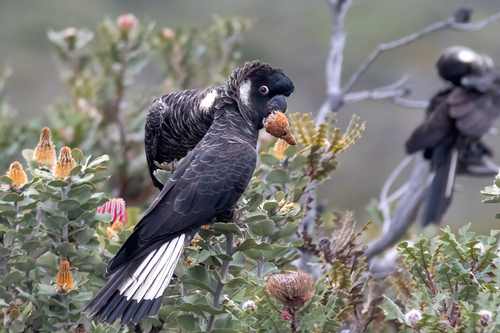
Flowers visited by
- Grey-headed Flying-foxunverifiedVulnerable
- Little Wattlebirdunverified
- New Holland Honeyeaterunverified
- Red Wattlebirdunverified
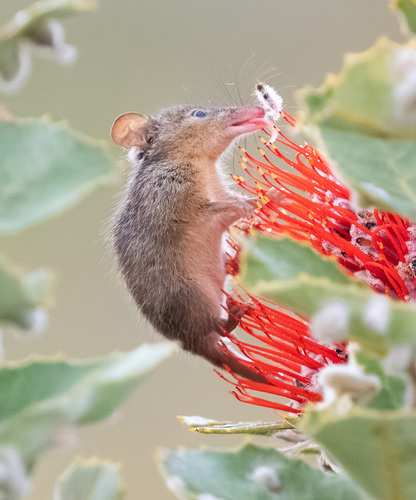 Honey Possumunverified
- Eastern Spinebillunverified
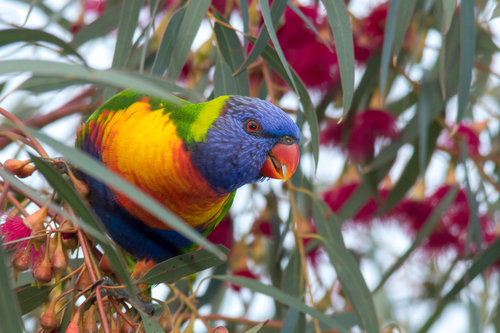 Rainbow Lorikeetunverified
Eaten by
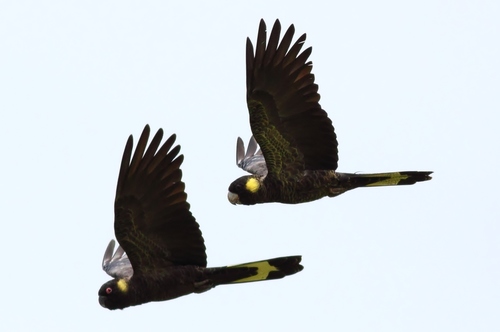
Where it belongs
Native to Cape York in Queensland, the Northern Territory and the northern Kimberley in Western Australia, plus southern New Guinea. It grows in savanna woodland and on rocky sandstone slopes, creek banks and gorges.
Suburbs it belongs in include:
Related plants
Sources
- Banksia dentata L.f. (Tropical Banksia), FloraBase, Western Australian Herbarium
- Banksia dentata, Wikipedia (ecology, fruit and distribution, cross-checked against FloraBase)
- Banksia dentata (Tropical Banksia), Top Tropicals plant encyclopedia
- Native range: Australian Plant Census and Alien Flora of Australia. Wildlife links: GloBI and the studies cited on each animal page. All sources